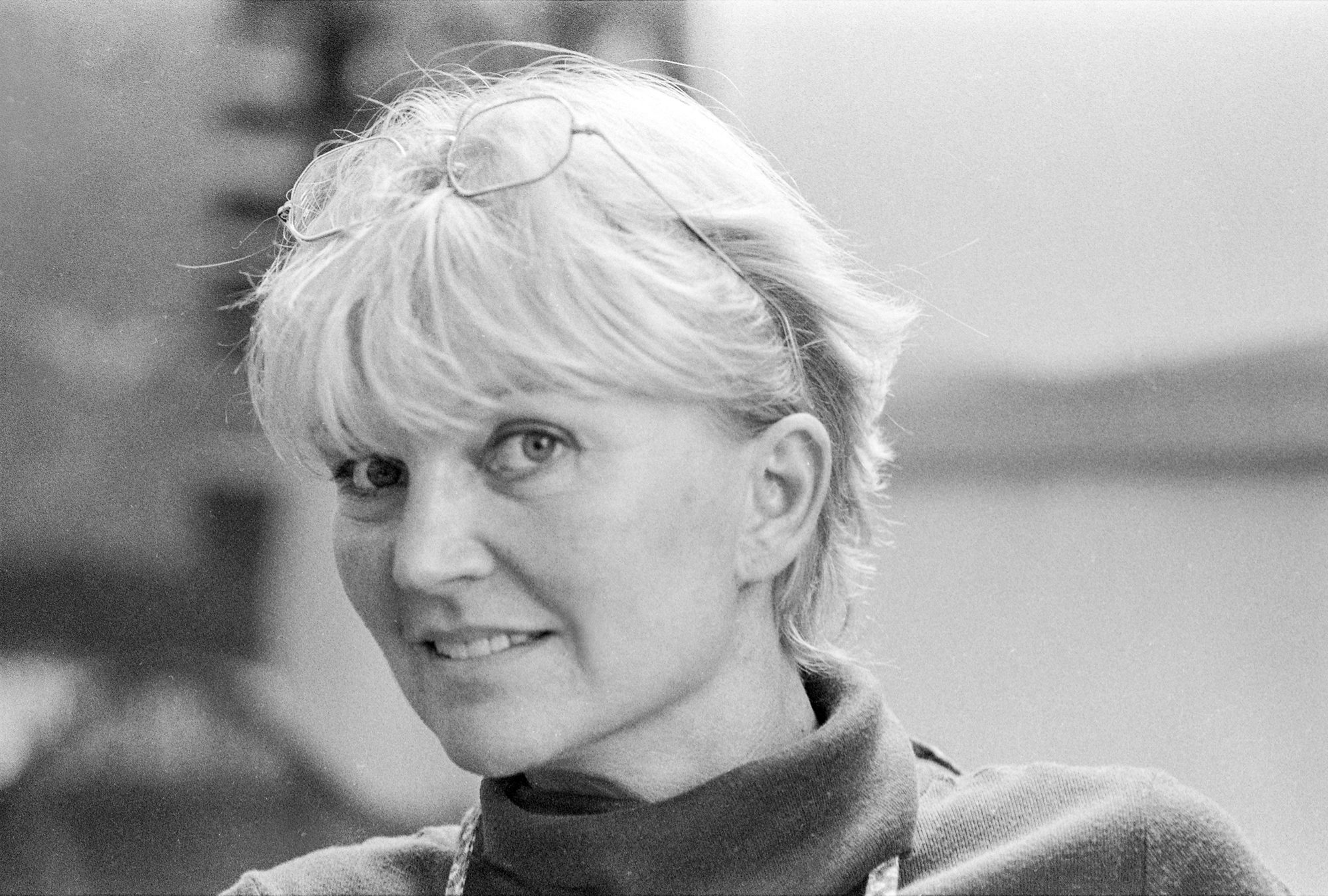
On January 24, 2023, artist Belinda Vidor Holliday slipped quietly out of a most exceptional life, surrounded by family and friends in her sunlit Carmel-by-the-Sea cottage, absent the fanfare she had earned but eschewed. She was 92. Born into the golden age of Hollywood and raised between two continents, she made herself, by her own determination, into a painter of the California coast — and found, late and gladly, the love of her life.
A Hollywood Childhood
Belinda Vidor was born in Los Angeles on June 12, 1930, three years behind her sister, Antonia, to two of the brightest names in American film. Her father, King Wallis Vidor (1894–1982), was a legendary director, producer, and screenwriter. Her mother, the gamine actress Olive Eleanor Boardman (1898–1991), had begun her career as a model for the illustrator John R. Neill, the photographer Arnold Genthe, and Eastman Kodak before becoming a star. The two had married in 1926, and two years later Eleanor gave what is still remembered as one of the great performances of the silent era, in her husband’s film The Crowd. Elegant, willowy, beautiful, actually, Belinda clearly got her mother’s wide-set eyes, lit by her father’s glycerin blue.
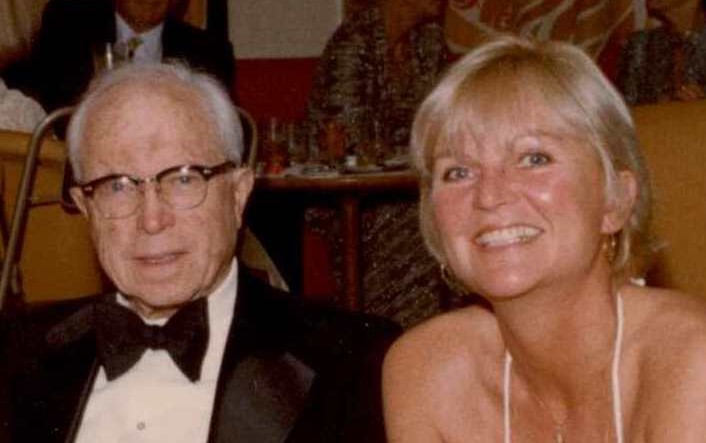
King Vidor’s 67-year career brought the silent film era to a close and ushered in the age of sound. Nominated five times for Best Director at the Academy Awards, he was considered an “auteur” director, one whose approach is so personal it is as if he were the author of the film. He reportedly won eight national and international film awards, including the Screen Directors Guild Lifetime Achievement Award, and in 1979 he received an Honorary Academy Award for his “incomparable achievements as a cinematic creator and innovator.” He believed that landscape was not a backdrop but a protagonist — a way of seeing his younger daughter would carry into her own work.
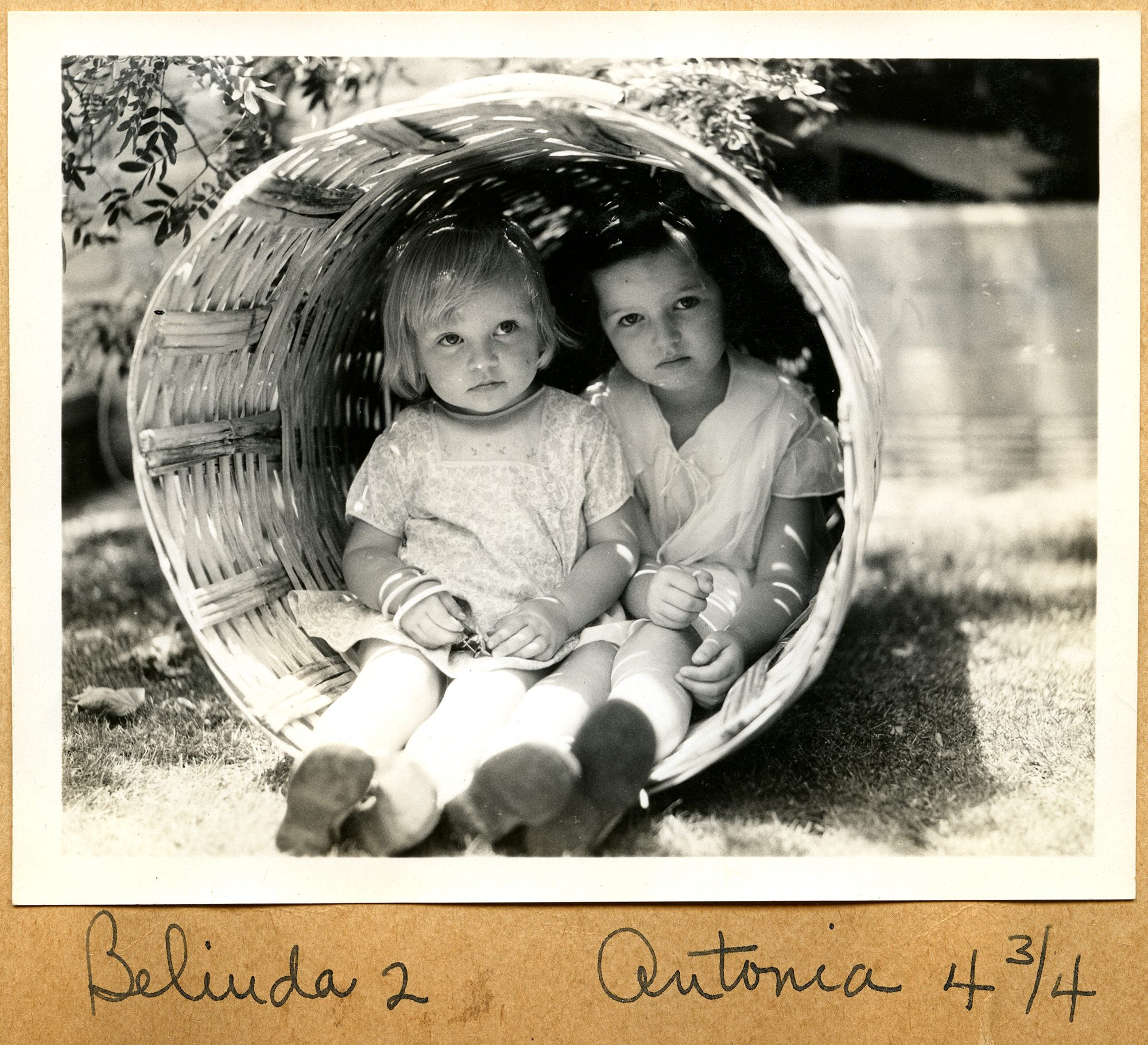
Belinda was just a year old when her parents separated; their divorce was final in 1933. Her mother, done with the halcyon days of Hollywood, took her daughters to France. In 1940 Eleanor married the French director and screenwriter Harry d’Abbadie d’Arrast, who had worked with Charlie Chaplin and earned an Academy Award nomination for his 1930 film Laughter. The family’s home in France was the d’Arrast estate, the Château d’Etchaux, in the Basque village of Saint-Étienne-de-Baïgorry in the Pyrenees. With a governess to look after them, the girls grew up between two continents — a peripatetic upbringing that would shape, in its way, everything she later wanted.
An Artist’s Training
Belinda ultimately returned to California to study. She attended Mills College in Oakland before transferring to the University of California, Los Angeles, where she studied under the painter Jan Stussy and graduated with a degree in art. Stussy taught at UCLA for more than four decades and was himself a man of many talents: in 1978 he would win an Academy Award for the documentary short Gravity Is My Enemy.
A Family in Modesto
After college, Belinda was invited to dine at the family home of her beau, Dean Jones, where she realized his parents actually knew his friends and interests, and participated in his life. She watched as dinner was served family style, and folks got up from the table to help with the dishes and reach for cookies hidden above the refrigerator. And she wanted that. She married Jones and moved with him to Modesto, in the Central Valley, where they raised three children: Stephen, Deverah, and Kenny. Her mother said to her, “I see what you wanted; a classic California home and a conventional family.” She didn’t understand it at the time, but in retrospect, she knew her mother was right.
Then came the loss no parent recovers from: her son Kenny died in an accident. In the years that followed, at 43, Belinda chose to reinvent her life.
Coming Home to Carmel
She chose Carmel-by-the-Sea, where her parents had summered by the sea when she was a child. When she arrived in town, she saw painters poised at their easels by the bay, cafés where people were leaning into the conversation, and an older woman, wearing a hat and brightly colored socks, walking uptown with her dog. Belinda was only 43, but she knew, ultimately, she wanted that.
The first time she saw the classic Carmel cottage rising out of an unruly garden sheltered by elderly oaks, she knew she’d come home. Built in 1923 by a young Michael J. Murphy for the artist Ada Belle Champlin, a Laguna Beach transplant who had come to Carmel to help establish an art association, the cottage carried the energy of creative intent. It had later belonged to the renowned painter Frank Montague Moore and his wife, who lived there until his death in 1967. Moore had made his studio in a room lit by a north-facing window. Belinda planned to do the same.
First, though, she had to secure it. She found herself in second place, behind a buyer whose offer had already been accepted. Undaunted, she was determined to move from Modesto and make a new life in the town her parents had introduced to her as a child. She knew the house was meant to be hers, even if it was going to take time to convince the seller — three and a half years, to be exact.
In the meantime, she took to visiting the vacant home, sweeping the paths and tending the grounds of a property for which she had already assumed emotional ownership. She bought herself a one-bedroom cottage in town, and from there she wrote to the widowed Mrs. Moore, campaigning for the chance to preserve the property as an artist’s cottage. Mrs. Moore, enchanted by the Carmel art colony connection, wanted Belinda to have the house — particularly after Belinda flew to La Jolla, where Mrs. Moore had relocated, bearing the gift of a painting. Ultimately, Belinda prevailed.
She named the cottage “Enfin” — “In the End” — a prescient harbinger of her intention to live out her life in her artist’s cottage by the sea. Decades later she learned that Champlin had called it “The Sketch Box.” The house’s history came full circle when Champlin’s great-niece, the novelist Joanna Fitzpatrick, came looking for it while researching her great-aunt; Belinda let her in, and the two became immediate friends. Fitzpatrick set much of her 2021 novel The Artist Colony, about the women painters of 1920s Carmel, inside the Sketch Box.
Belinda Vidor Holliday joined the juried membership of the Carmel Art Association in 1990.
The Painter
In Carmel, Belinda became the painter she had trained to be. She worked in oil across an unusually wide range: small plein air landscapes of the coast and the Monterey Peninsula, vineyards and gardens, large abstract canvases built from fanciful shapes, portraits of large groups of people, and, in her later years, a series of florals. Her landscapes, many of them oil on board, are often described in the tradition of the California Impressionists who first made Carmel an art colony.
In 1990 she was juried into the Carmel Art Association, the artist-run gallery founded in 1927 by Carmel’s early painters. “Whether one is viewing Belinda’s small plein air landscapes, her distinctive large abstracts constructed from fanciful shapes, her portraits of large groups of people, or her most recent series of florals, one thing is for certain,” said Sally Aberg, the association’s gallery manager. “There is a freshness and boldness in all of Belinda’s paintings.” Her paintings found their way to a wide community of collectors.
She painted at her father’s French easel, set in the light of the cottage’s living room. She was still painting there in her last days, and an unfinished canvas remains on it.
Jim
What she didn’t realize she also wanted, until she met him, was the love of her life. In March 1982 Belinda went to a book signing for The World Rushed In: The California Gold Rush Experience, the celebrated history its author had spent some thirty years writing. The author was Jaquelin Smith Holliday II, who preferred “Jim” — Yale graduate, Navy veteran, Berkeley Ph.D., founding director of the Oakland Museum of California, and twice executive director of the California Historical Society.
In July 1982, Belinda went on her first date with the dashing California historian. Three weeks later they exchanged their first “I love you,” as recorded in her diary of significant dates with the man she married on June 11, 1983. Equally scholarly and social, Jim was, first and foremost, a family man, whose children and stepchildren considered him a mentor, a force, and a wonderful father. Belinda said he was her “husband, her champion, her best friend, her dream come true.”
Their life together was rooted in Carmel — in the cottage, in the town’s civic life, and in a wide circle of writers, artists, and friends — and, from the early 1990s, in the Sierra foothills as well. In the late 1980s Belinda’s son Stephen found a piece of land above a private lake near North Fork, in Madera County, in the Gold Rush country Jim had spent his life studying. Jim and Belinda bought it, and over 1991 and 1992 they built a house there: massive open beams soaring over the main room, and a wide veranda wrapping the house on all sides, turned toward the water. It joined the historian’s reverence for early California with the painter’s instinct for how a place should be seen, and it remains in the family today as the Holliday Lake House.
The Sculptor
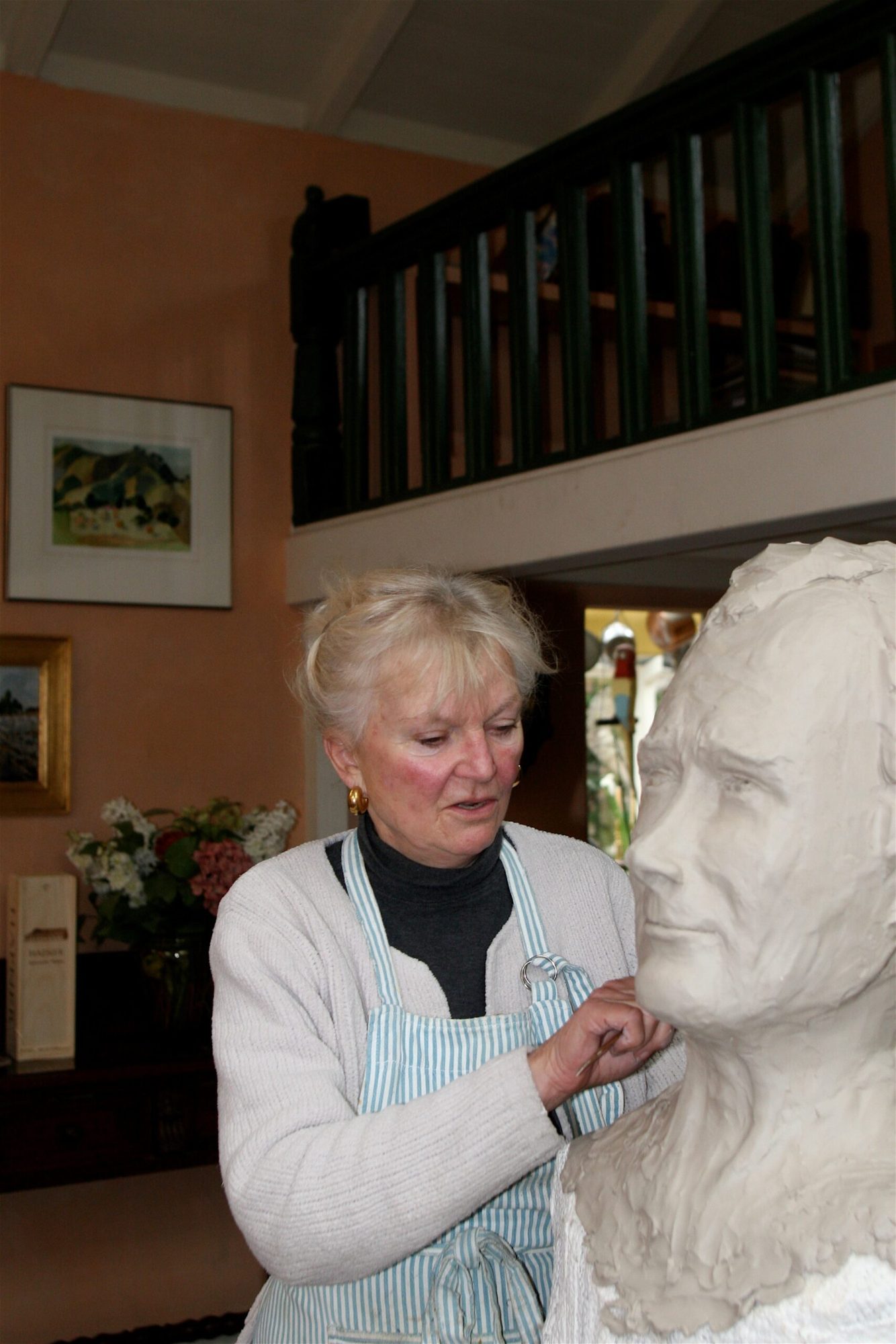
Belinda was a sculptor as well as a painter. Her portrait bust of Jim, made after his death in 2006, was unveiled at the California State Library in Sacramento, whose rare book room was named in his honor as the J.S. Holliday Rare Book Room — a fitting home for the likeness of a man who had spent his life among diaries, letters, and old books.
A Vital Life
After Jim’s passing, Belinda left her heart with him, and turned her attention to her family and friends, her art, and her devotion to dogs. She leaves behind “Buster,” a Parsons Jack Russell she rescued, though she always believed he rescued her. As she moved into her senior years she continued to celebrate life, firmly believing, “If you sit back and complain about being old, that’s when you deteriorate. I don’t dislike where I am; I just need to keep practicing a vital life.”
She practiced it to the end, in the cottage she had waited three and a half years to call her own, in the town she had chosen at 43, among the paintings and the people she loved.
Belinda Vidor Holliday was preceded in death by her son, Kenny, and is survived by her son, Stephen Jones (Laurie Flanagan) and their sons, Austin, Connor, and Quintin; daughter, Deverah Tipton (Ron), and their sons Michael (Karen), Jon (Stephanie), and Stephen (Mindy); beloved friend Lilli Dean; stepchildren Tim Holliday (Lucia), Brett Holliday, and Jack Holliday; great-grandchildren Avery, Hayden, Holly, Riley, and Wyatt; a circle of dear friends, a wide community of art collectors, and Buster!
A Life in Brief
- 1930
- Born June 12 in Los Angeles to King Vidor and Eleanor Boardman
- 1930s
- Parents divorce (1933); moves with her mother and sister to France
- 1940
- Mother marries director Harry d’Abbadie d’Arrast; family estate in the Basque Pyrenees
- College
- Mills College, then UCLA, studying art under Jan Stussy
- Modesto
- Marries Dean Jones; raises Stephen, Deverah, and Kenny
- 1970s
- Moves to Carmel at 43; wins the 1923 artist’s cottage she names “Enfin”
- 1982
- Meets historian J.S. “Jim” Holliday at a book signing
- 1983
- Marries Jim Holliday, June 11
- 1990
- Juried into the Carmel Art Association
- 1991–92
- Builds the Holliday Lake House in North Fork with Jim
- 2006
- Jim dies; her bust of him is later unveiled at the California State Library
- 2021
- Her cottage appears in Joanna Fitzpatrick’s novel The Artist Colony
- 2023
- Dies January 24 at home in Carmel, aged 92